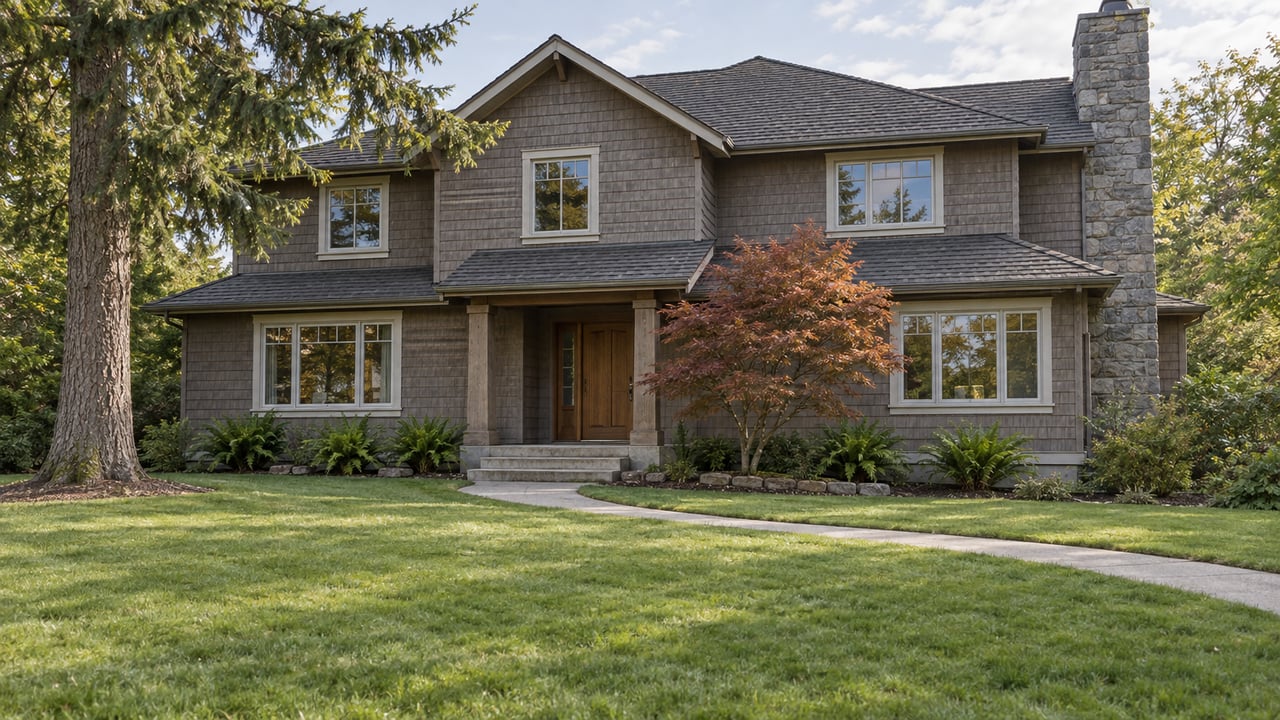
How does a city where the average home is valued around $4 million end up short on operating money? Clyde Hill's answer will be on ballots for the November 3 general election. Ballots were mailed on October 14, and the measure is now 12 days from Election Day.
If you're comparing Clyde Hill with Bellevue, Medina or Kirkland, the city tax rate looks like a clear win for Clyde Hill. In 2026 King County lists Clyde Hill's municipal levy at $0.29548 per $1,000 of assessed value. Bellevue's is $0.96050 and Medina's is $0.58700. A state rule caps how many dollars a city can collect each year, so the rate falls whenever home values rise faster than those dollars.
The rate fell because home values rose
Washington uses a budget-based property tax. As the Municipal Research and Services Center explains, a taxing district first sets the dollar amount it will levy. The assessor then divides that amount by the district's total taxable assessed value to get the rate per $1,000.
The cap applies to the dollar amount. Without voter approval or banked capacity, a district's regular levy can generally grow only 1% a year. New construction and certain other additions are counted separately. The formula is in RCW 84.55.010. According to the City of Clyde Hill's levy FAQ, the limit dates to Initiative 747 in 2001. The FAQ also says cities under 10,000 residents, Clyde Hill among them, cannot raise their total levy from existing assessed value by more than 1% a year without voter approval.
MRSC gives a simple example. Double a district's assessed values, let its levy dollars grow by only 1%, and its rate drops from $2.00 to $1.01 per $1,000. The city's FAQ puts the same idea in one line. Asked whether the city collects more money when assessed value goes up, it answers, "Not necessarily."
That is how a high-value city ends up with the third-lowest city levy rate in King County, according to the FAQ.
Where a Clyde Hill property tax dollar goes
Since the city rate is small, most of a Clyde Hill bill goes elsewhere. Here is the 2026 breakdown for levy code 1053 from the King County Assessor's 2026 rate book, compiled February 19, 2026.
| 2026 component, levy code 1053 | Rate per $1,000 |
|---|---|
| State school levy, regular and McCleary | $2.24959 |
| Bellevue School District 405 | $1.92214 |
| King County levies | $1.45642 |
| City of Clyde Hill | $0.29548 |
| Emergency medical services | $0.25098 |
| Library | $0.23534 |
| Sound Transit | $0.15866 |
| Port of Seattle | $0.09877 |
| Flood control district | $0.09419 |
| Total | $6.76157 |
Clyde Hill's other levy code, 1052, totals $7.25796 for 2026. The difference is the $0.49639 Evergreen Hospital District 2 levy, which applies only to that code.
At the 2026 code 1053 rates, multiplying the total rate by a $4 million assessment gives about $27,046. About $1,182 of that comes from the city rate. The city says it received less than 5 cents of every property tax dollar paid in 2026.
That proportion matters when you read about the ballot measure. Moving the city levy from about $0.30 to $0.50 is roughly a 69% increase in the city's rate, as The Urbanist reported in July. Against the full 2026 code 1053 total of $6.76157, the same change works out to about a 3% increase in the combined rate.
Why the neighboring rates look higher
The city rates in King County's 2026 table aren't all just "regular" levies. Part of Bellevue's $0.96050 is a $0.21546 levy lid lift. Part of Medina's $0.58700 is a $0.16904 levy lid lift.
So two of the cities buyers most often compare with Clyde Hill already collect money above the 1% path. Clyde Hill's 2026 table shows no lid-lift line, and its city rate is only its regular levy.
Total rates have also come down across the city's levy codes. King County's 2020 table listed Clyde Hill's total rates at $8.42022 for code 1052 and $8.14281 for code 1053. That change covers every district on the bill, not only the city. It does show that falling rates and rising values happen together, which is exactly how a budget-based system is designed to work.
What the city says the cap has done to its budget
In December 2024 the city created a resident-led Financial Sustainability Task Force to review its finances, staffing and long-term trends. Its January 20, 2026 report found the following:
- The city had almost $6 million in reserves for general operating expenses.
- It ran an operating deficit in 5 of the previous 7 years, totaling almost $1.8 million. The report says American Rescue Plan Act money accounted for the two years without a deficit.
- It named three main causes: Initiative 747, new state regulatory requirements without implementation funding, and pay adjustments to recruit and keep police officers.
- It estimated the city would assess about $1.3 million in property taxes in 2026, with a maximum of $1.313 million in 2027 under the normal limit.
The report also shows what Clyde Hill has besides property tax, and the list is short. The city's 0.1% criminal justice sales tax brings in about $120,000 a year. Development fees topped $900,000 in 2025, and the task force projected about $50,000 a year from a 5% fee increase. With its levy capped and little commercial activity to tax, the city depends partly on residents remodeling and rebuilding. The Urbanist put Clyde Hill's 2026 budget at about $6.7 million.
Some cuts have already been made. The city's preliminary 2027 budget announcement lists eliminated items, including a maintenance worker position, a paid intern and Clyde Hill Days. Mayor Dean Hachamovitch described the 2027 plan as "a status quo budget, keeping our services whole for 2027 through a modest draw from our reserves—a bridge, not a fix."
What Proposition 1 would change
Here is the ballot title in King County Elections' measure listing:
Levy to Continue Providing Public Safety and Land Use Services in Clyde Hill
The explanatory statement says that if voters approve it, the city levy rises from $0.29548 per $1,000 in 2026 to no more than $0.50 per $1,000 in 2027. From 2028 through 2036, the total regular levy amount would rise by a 3% limit factor each year instead of the usual 1%. The 2036 levy then becomes the base for later years. The money would pay for police, fire, emergency medical services, 911 dispatch, land use and zoning.
The 3% piece matters as much as the first-year jump. The jump resets the base, and the 3% factor sets how fast the city's levy dollars can grow for the following nine years.
The city estimates the first-year cost at about $225 per $1 million of assessed value, or about $900 for an average $4 million home. Multiplying the 2026 rate and the $0.50 cap against a $4 million value gives a smaller difference, about $818. The FAQ explains why the numbers can differ: voters approve a levy amount, and the actual 2027 rate depends on 2027 assessed values.
If the measure fails, the city's explanatory statement says Clyde Hill is projected to run out of operating funds by the end of 2030 and "may need to consider dissolution." The city's FAQ says the choices would be cutting services or merging with another city, and that merging would cost taxpayers more because neighboring cities have higher levy rates.
The statement in favor says Clyde Hill receives about 4.5% of the total property tax bill. It lists city rates of $0.30 for Clyde Hill, $0.59 for Medina, $0.96 for Bellevue and $0.86 for Kirkland. King County notes that no statement in opposition was submitted because the opposition committee withdrew. The city has collected its task force materials and meeting records at clydehill.org/LevyLidLift.
Key dates from here:
- November 3, 2026: Election Day.
- November 10, 2026: The council is expected to adopt the final 2027 budget, and residents can give testimony at that meeting.
- 2027: The first tax year affected if the measure passes, with the rate based on 2027 assessed values.
Quick answers
Does Proposition 1 change the school, county or transit portions of a Clyde Hill bill? No. The explanatory statement describes the measure as an increase to the city's portion of property taxes.
Are any homeowners exempt? The ballot title says exemptions apply to seniors, veterans and disabled persons who qualify under RCW 84.36.381. Eligibility details are on the King County Assessor's exemption page.
Does a higher assessment automatically mean the city collects more? No. Under the 1% limit, the city's levy dollars stay capped, so a higher assessment mostly changes how the levy is split among properties. It doesn't raise the city's total.
This post is general information, not legal, tax or financial advice. Please confirm your own tax situation, and any exemption you might qualify for, with the King County Assessor or a tax professional.
When you're comparing Clyde Hill with Bellevue or Medina, it helps to look at the full levy code for each address along with the headline city rate. If you'd like help reading a property's tax history next to the homes you're considering, Ankush Homes is glad to go through it with you. Let's Connect.